
Written & Reviewed by
Dr. Choe Jeongheon
General Surgeon · Orthopedic Clinic Director · MD, PhD
Founder of MADI-BONE CLINIC, Seoul. 10+ years of experience in musculoskeletal medicine and private orthopedic care.
When Forward Head Posture Hurts Even in Your 20s: Why Early Treatment Matters
By MADI-BONE CLINIC | Gangnam (Seolleung Station)
“You Can See It Even Without Reading the X-ray”
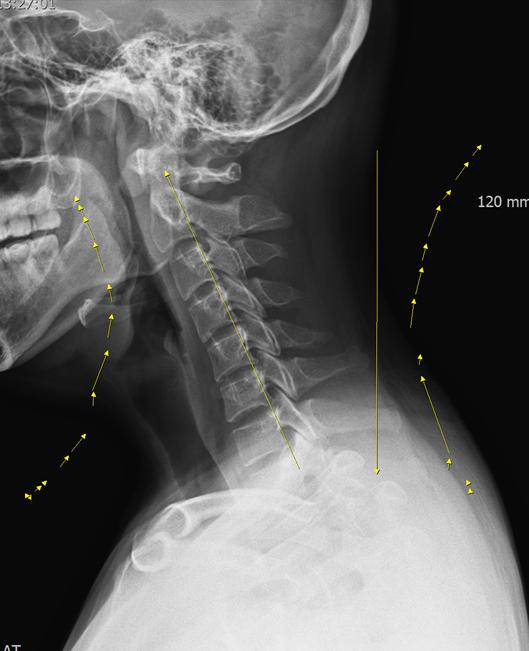
Sometimes, you don’t need to be able to read an X-ray to see the problem.
In forward head posture, the patient’s neck visibly shifts forward, and the normal C-shaped cervical curve becomes straightened or even reversed.
This is what many people call “tech neck” or “forward head posture (FHP)”.
In these cases, patients often complain of:
- heavy, dull pain around the neck and upper trapezius
- tension-type headaches when symptoms are more severe
Yes, It Can Be Severe Even in the Early 20s
In this case, the patient was in their early 20s, yet the pain intensity was already high.
We started with injection therapy to reduce pain and agreed to consider posture correction afterwards.
It is a common misconception that forward head posture becomes a problem only at an older age.
In reality, prolonged device use, extended study hours, and sedentary habits can lead to:
- persistent neck pain and muscle tension
- increased activity in superficial neck muscles (e.g., upper trapezius)
- headaches originating from the neck region
Studies have shown a relationship between forward head posture and neck pain and highlight the role of posture-focused exercise and deep cervical flexor training in improving symptoms.
(For example: González-Sánchez et al., 2020; Kim & Kim, 2016; Blanpied et al., 2017 clinical practice guideline.)
Our Usual Treatment Framework for Forward Head Posture
When we diagnose forward head posture, we usually think in three layers:
- Pain-focused treatment — often injection therapy when pain is significant
- Long-term posture correction — manual & exercise-based therapy (therapeutic exercise)
- Ongoing maintenance — consistent physical therapy and habit correction
1) Injection Therapy (Pain Reduction)
If pain is high, we may start with injection therapy (e.g., trigger point or periarticular injections) around the neck and shoulder region to:
- reduce pain intensity
- relax highly sensitized muscles
- allow the patient to participate in exercise and posture correction more comfortably
2) Manual & Exercise Therapy (Correction)
For structural and functional correction, we focus on:
- deep cervical flexor activation (chin-tuck and related exercises)
- thoracic mobility (upper back extension and mobilization)
- scapular stabilization (retraining shoulder blade position and endurance)
- education on screen height, sitting posture, and break routines
Clinical guidelines and trials support a combination of exercise therapy and manual therapy for neck pain and cervicogenic symptoms. (Neck Pain CPG, JOSPT 2017; Kim & Kim 2016 for deep cervical flexor training.)
3) Physical Therapy & Lifestyle Maintenance
Once pain is under control and posture exercises have started, regular physical therapy can help:
- maintain muscle balance
- prevent regression into old patterns
- support long study or work hours with less discomfort
Different Patients, Different Approaches
Patients approach treatment in very different ways:
- Some patients choose to receive injection therapy whenever pain flares, treating it like “maintenance” or repair work.
- Others combine injection plus manual & exercise therapy and aim for a more thorough correction, hoping to reduce symptoms in the long term.
There is no single “perfect” answer for everyone.
When we decide on a treatment strategy, we always consider:
- the patient’s daily routine and posture habits
- treatment cost and insurance situation
- time budget (how often they can visit and how much home exercise they can realistically do)
- their personal goals: short-term pain relief vs long-term correction
In short: treatment is not “one-size-fits-all.”
It is a customized plan balancing pain control, structural correction, and real-life constraints.
When Should a Young Adult Get Checked?
- Persistent neck and trapezius tightness despite rest or stretching
- Headaches that seem to start from the neck/shoulder region
- A clearly visible forward head posture in photos or mirror
- Pain that is already affecting study, work, or sleep
The earlier we diagnose and treat, the shorter the treatment time and the better the chance to correct posture before it becomes fixed.
MADI-BONE CLINIC (Seolleung Station, ~3 min on foot)
MADI-BONE CLINIC
3F, 428 Seolleung-ro, Gangnam-gu, Seoul
Seolleung Station (Line 2), Exit 1 — ~3 minutes on foot
02-736-2626
⏰ Mon–Fri 09:30–18:30 / Sat 09:30–13:00 (Closed Sundays & Public Holidays)
Sources (for interested readers)
- González-Sánchez M, et al. The relationship between head posture and neck pain (systematic review). Musculoskelet Sci Pract. 2020.
- Kim EK, Kim JS. Effect of deep cervical flexor training on forward head posture and pain. J Phys Ther Sci. 2016.
- Blanpied PR, et al. Neck Pain: Clinical Practice Guidelines (Revision 2017). JOSPT / Orthopaedic Section CPG.
This article is for educational purposes and does not replace an individual medical evaluation or treatment plan.