Learn simple at-home checks to spot early signs of teen scoliosis and know when to see a spine specialist.
Early Signs of Teen Scoliosis
By MADI-BONE CLINIC — Seolleung, Gangnam
Why Early Detection of Teen Scoliosis Matters
Scoliosis in teenagers often starts quietly.
There is usually no dramatic “injury moment” — no fall, no sudden event.
Instead, the spine gradually curves as the child grows,
and by the time the change is visible, the curve may already be significant.
The good news is that scoliosis progression is closely linked to the growth period.
If we detect it early, we can:
- monitor the curve size carefully
- protect the spine during growth spurts
- use exercise, bracing or manual therapy when appropriate
- reduce the risk of severe long-term deformity and pain
This article offers a simple, practical checklist for parents and teens to
spot early signs of scoliosis — and to know when to come in for a proper evaluation.
What Is Teen Scoliosis?
Scoliosis is a condition in which the spine curves sideways,
often forming an “S” or “C” shape when viewed from behind.
In adolescents, it is usually called
Adolescent Idiopathic Scoliosis (AIS) — meaning:
- it develops during the growth spurt years
- there is no clear single cause
- it can progress as the child grows taller
Most cases are mild, but some curves can progress and affect:
- appearance and posture
- back pain and muscle fatigue
- lung capacity in severe cases

A Simple At-Home Checklist for Parents
You do not need special equipment to suspect early scoliosis.
A careful look at posture can reveal many clues.
Use the following checklist as a guide.
If you notice several signs, it is wise to schedule an evaluation.
1. Shoulder Height Asymmetry
Stand your teen in front of you, feet hip-width apart, arms relaxed.
Look at the shoulders:
- Does one shoulder sit higher than the other?
- Does one shoulder appear more rounded or forward?
Mild differences are common, but clear, consistent asymmetry — especially if it increases over time —
may indicate spinal rotation and curvature.
2. Uneven Shoulder Blades (Scapulae)
From behind, check the shoulder blades:
- Is one shoulder blade more prominent?
- Does one stick out more than the other?
- Does one appear higher or closer to the spine?
A rotated ribcage or curved spine can cause one scapula to “wing” more than the other.
3. Asymmetric Waist or Flank Lines
Now look at the waist area:
- Are the indentations at the waist different on each side?
- Does one side look “straighter” while the other curves in more?
This is a common early sign that the spine and pelvis are not aligned symmetrically.
4. Pelvis or Hip Height Difference
Check the level of the hips from behind:
- Does one hip appear higher?
- Does clothing or a belt sit crooked?
An apparent “leg length difference” can sometimes be related to spinal curvature or pelvic tilt.
5. Head Not Centered Over the Pelvis
Stand directly behind the teen and look from the head down to the pelvis.
Imagine a straight vertical line:
- Does the head line up with the center of the pelvis?
- Or does it appear shifted to the left or right?
Deviation from center can be a subtle but important indicator.
6. Clothing Hanging Unevenly
Sometimes clothing reveals more than the body alone:
- Does the hem of a shirt tilt to one side?
- Do pant legs seem different lengths even when they are not?
- Does the collar line sit diagonally on the neck?
When the same pattern appears repeatedly with different clothing,
structural asymmetry may be present.
7. The Forward Bend Test (At-Home Version)
Ask the teen to:
- stand with feet together
- slowly bend forward at the waist
- let arms hang freely toward the floor
From behind, observe the ribcage and back muscles:
- Is one side of the ribcage higher?
- Is there a noticeable “hump” on one side?
This is similar to the clinical Adam’s forward bend test and often reveals rotational deformity.

8. Back Pain or Fatigue During Studying
While mild discomfort can be normal after long sitting,
persistent back pain in a teenager is not something to ignore.
Ask:
- Do you feel tired or tight in the back after short study periods?
- Do you often change position to relieve discomfort?
- Is the pain always in the same area?
Scoliosis itself is not always painful,
but muscle imbalance and postural strain can create recurring fatigue.
9. Shortness of Breath During Activity (More Advanced Cases)
In more severe curves affecting the ribcage,
teens may experience:
- shortness of breath with mild exertion
- reduced sports performance
- unequal chest expansion when breathing
This requires timely medical evaluation.
How Often Should Parents Check?
During rapid growth (typically early to mid teens),
it is reasonable to:
- visually check posture every few months
- pay attention to clothing changes and complaints of discomfort
- consider professional screening if there is any family history
The key is not to create anxiety, but to develop awareness —
to notice changes early rather than discovering scoliosis by chance years later.
What We Do at the Clinic When Scoliosis Is Suspected
If you come to MADI-BONE CLINIC with concerns about scoliosis,
our evaluation typically includes:
- detailed growth and family history
- postural and gait assessment
- Adam’s forward bend test
- measurement of any visible asymmetry
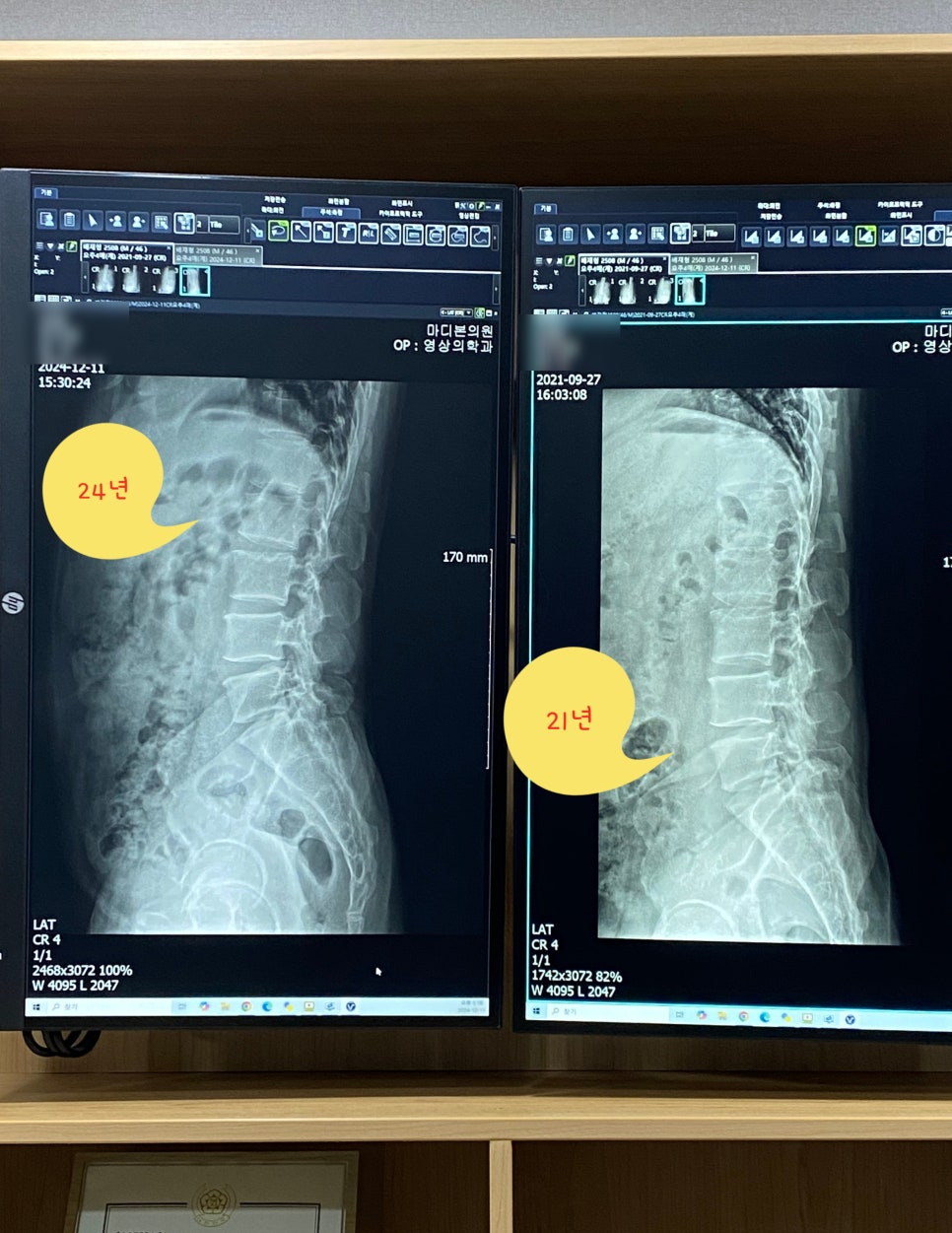
- X-ray imaging when clinically indicated
If scoliosis is present, the X-ray allows us to:
- measure the curve size (Cobb angle)
- assess which segments are involved
- evaluate growth stage and risk of progression
From there, we discuss options such as observation, exercise-based programs,
manual therapy, or referral for bracing in more advanced cases.
Teens vs Adults: Different Goals in Scoliosis Care
In adolescents, the primary goal is to:
- monitor curve progression during growth
- intervene early if the curve is worsening
- protect the spine through targeted strengthening and postural care
In adults, curvature usually stops progressing significantly once growth is complete.
The focus becomes:
- preventing further deterioration
- reducing pain and muscle fatigue
- maintaining quality of life and mobility
How Sitting Time and Study Habits Influence Teen Scoliosis
As mentioned in a previous article on spinal load,
sitting places more pressure on the spinal discs than lying or even standing.
For Korean adolescents, who often spend long hours at desks,
this is especially relevant.
Long sitting:
- fatigues core and back stabilizer muscles
- encourages slouching and asymmetrical postures
- can amplify the visible effects of scoliosis
Encouraging:
- regular stretch breaks
- standing or walking between study blocks
- simple home core exercises
…can support a healthier spine during the critical growth years.
What Parents Can Do Day-to-Day
- Observe posture calmly, without alarming the teen
- Encourage regular physical activity, not just desk time
- Promote balanced sports or exercises that strengthen the trunk
- Watch for consistent asymmetry, not one-time changes
- Seek evaluation early if you are unsure — not after years of waiting
Scoliosis is not caused by “bad posture alone”, but posture and muscle balance strongly influence
how the spine tolerates growth and daily load.
Related Articles from MADI-BONE CLINIC
For more background on spine health and posture:
- Why Sitting Increases Disc & Scoliosis Risk
- Why Pain Lasts Even Without a Fracture
- When MRI Truly Matters for Injury Detection
Frequently Asked Questions (FAQ)
1. Can I diagnose scoliosis at home?
No. You can only suspect scoliosis at home using posture checks.
A proper diagnosis requires clinical examination and usually X-ray measurement.
2. If my teen has a small curve, does it always get worse?
Not always.
Many mild curves remain stable, especially after growth is complete.
However, the risk of progression is highest during growth spurts,
which is why monitoring is important.
3. Can exercise alone fix scoliosis?
Exercise can:
- reduce pain and fatigue
- improve posture and muscle balance
- support spine health during growth
But it does not “erase” structural curvature.
The realistic goal is control and support, not perfection.
MADI-BONE CLINIC — Seolleung Station
MADI-BONE CLINIC
3F, 428 Seolleung-ro, Gangnam-gu, Seoul
Seolleung Station (Line 2), Exit 1 — ~3 minutes on foot
📞 02-736-2626
⏰ Mon–Fri 09:30–18:30 / Sat 09:30–13:00 (Closed Sundays & Public Holidays)