Golf Season, Sore Elbows: Fast Relief vs. Lasting Recovery
By MADI-BONE CLINIC | Gangnam (Seolleung Station)
Every Autumn, the Same Story
When patients start asking for quick fixes before tee time, we know the fall golf season has begun. Many golf lovers carry small, nagging pains, but the most frequent reason they visit us is pain in both hands and both elbows—especially around the medial or lateral elbow.
Tennis Elbow vs. Golfer’s Elbow — The Usual Suspects
Two tendon problems dominate in golfers:
- Tennis elbow (lateral epicondylitis): outer elbow pain where wrist extensor tendons attach. Often worse with wrist extension.
- Golfer’s elbow (medial epicondylitis): inner elbow pain where wrist flexor tendons attach. Often worse with wrist flexion.
Because these tendon units run from the elbow down toward the wrist, excessive wrist use and gripping are frequent triggers. Racket sports share the same risk pattern.
“I Need to Feel Better Fast” — What We Can Do
When rapid pain reduction is needed (e.g., a scheduled round), we may combine:
- Ultrasound-guided anti-inflammatory injection to settle acute pain and enable rehab.
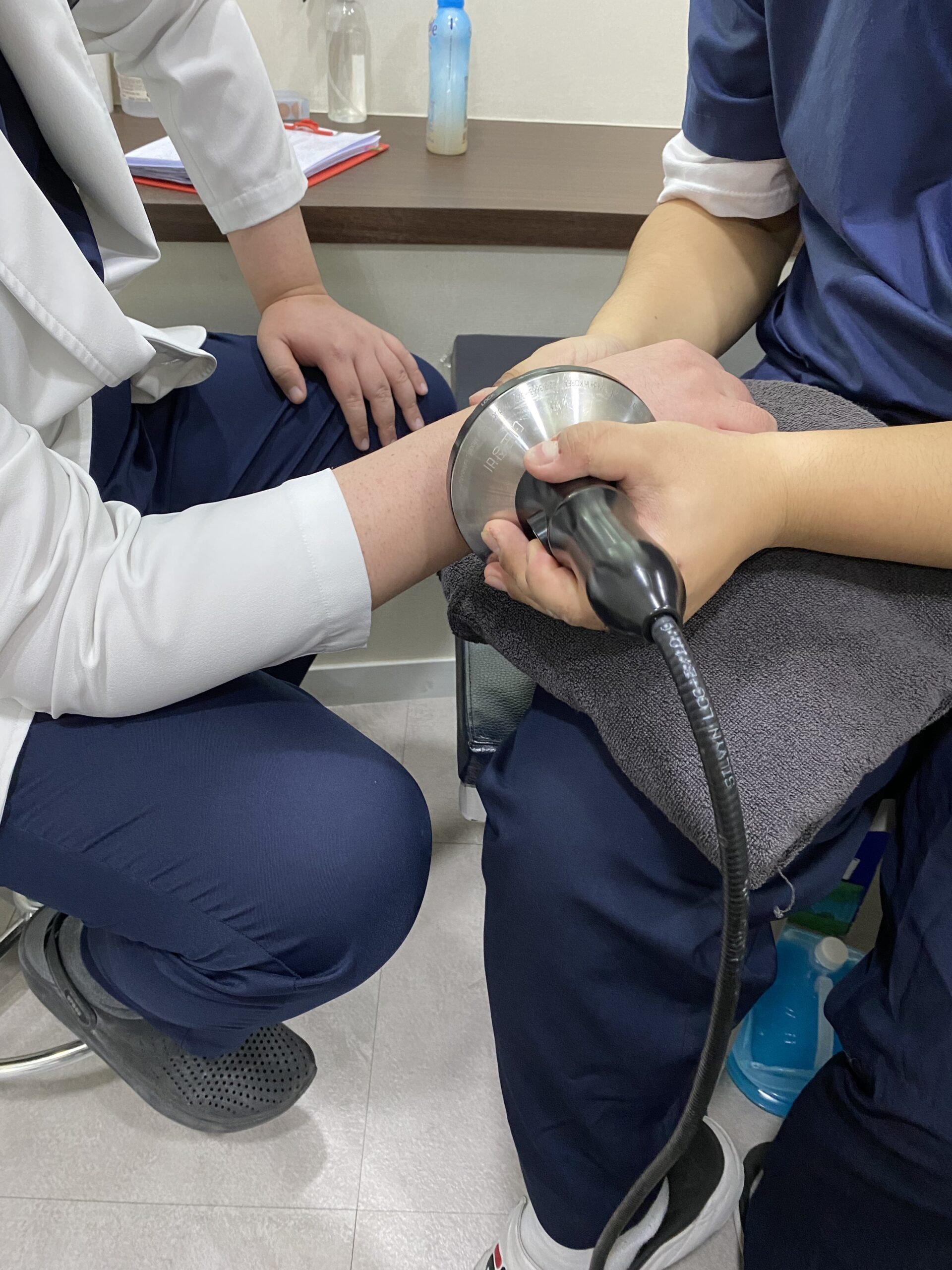
- Shockwave therapy (ESWT) for chronic tendinopathy patterns, often paired with eccentric or heavy-slow resistance loading in rehab. Evidence supports ESWT as a noninvasive option for several tendinopathies, though results vary and should be individualized. Systematic review, recent review.
Note: Corticosteroid injections can provide short-term pain relief but are associated with higher recurrence and worse long-term outcomes compared with exercise-based care in lateral epicondylalgia. We select indications carefully. Bisset et al., RCT; Coombes et al., JAMA; BMJ Open review.
Why Symptoms Linger If You Keep Playing
Swinging “through pain” creates a micro-trauma accumulation loop—repetitive load exceeding current tendon capacity with insufficient recovery. The tendon may move along the continuum from reactivity to disrepair/degeneration if load errors persist. BMJ overview.
Regenerative Options Some Patients Ask About
- PRP (platelet-rich plasma): considered in chronic or refractory elbow tendinopathy; several trials show benefit, though debate remains across protocols. Mishra et al., AJSM 2014; pilot study.
- PDRN (polydeoxyribonucleotide) / so-called “DNA” injections: early evidence from musculoskeletal conditions suggests pain improvement, but high-quality, elbow-specific RCT data are limited; consider case-by-case. systematic review 2021; narrative review 2023.
Choice depends on symptom chronicity, prior treatments, sport schedule, and patient goals; we discuss pros/cons together.
Early Diagnosis Beats Waiting Until It’s Severe
Patients who have “been there” often return for early shockwave or consider PRP/PDRN when symptoms start to climb—long before the big game.
Catching it early reduces total treatment time and generally improves outcomes. For first-line care, guideline-consistent management emphasizes exercise, manual therapy, and load management. BMJ review, physiotherapy management review.
A Practical Plan Before Your Next Round
- Deload for 3–5 days (pause painful drills; reduce volume/intensity).
- Eccentric/HSR loading: 3–5 s lowering, 12–15 reps × 2–3 sets for wrist extensors/flexors, within tolerable pain. (overview)
- Forearm stretches 30–40 s × 2–3 reps; reassess grip size and wrist angles.
- If a fast pain drop is essential, discuss an ultrasound-guided injection and/or ESWT to enable rehab—not to replace it.
- Progress volume by ~10–20% weekly only if symptoms are stable or improving.
When to Seek Care Promptly
- Pain persists or worsens despite rest/ice for 3–4 days
- Noticeable weakness, numbness/tingling, or suspected tendon tear
- Post-traumatic swelling/bruise, fever, or night pain disrupting sleep
MADI-BONE CLINIC (Seolleung Station, ~3 min on foot)
MADI-BONE CLINIC
3F, 428 Seolleung-ro, Gangnam-gu, Seoul
Seolleung Station (Line 2), Exit 1 — ~3 minutes on foot
02-736-2626
⏰ Mon–Fri 09:30–18:30 / Sat 09:30–13:00 (Closed Sundays & Public Holidays)
Sources
- Bisset L, et al. Mobilisation with movement & exercise vs corticosteroid injection (52-week RCT). BMJ, 2006 (open version: PMC).
- Coombes BK, et al. Corticosteroid injection, physiotherapy, or both. JAMA, 2013. Long-term outcomes summarized also in BMJ Open, 2013.
- Coombes BK, et al. Lateral epicondylalgia — epidemiology, pathophysiology & management. BMJ, 2010.
- Schmitz C, et al. ESWT in musculoskeletal disorders (systematic review). 2015; recent overview 2025.
- Mishra AK, et al. PRP for chronic tennis elbow (RCT). AJSM, 2014; pilot data 2006.
- Gwak DW, et al. Does PDRN help tendon/ligament disorders? (systematic review). Medicina, 2021; broader review Int J Mol Sci, 2023.
This article is educational and does not replace an individual medical evaluation or treatment plan.