Most ankle injuries are sprains, but not all are simple. Learn why proper diagnosis matters after ankle trauma.
Not All Ankle Sprains Are the Same
By MADI-BONE CLINIC — Seolleung Station, Gangnam
Ankle Injuries in Office Districts
Located in the Teheran-ro area, our clinic sees a large number of office workers.
As a result, most traumatic injuries are relatively minor.
Patients often visit after slipping on stairs,
missing a step, or twisting their ankle during daily activities.
In many cases, these injuries are diagnosed as ankle sprains.
Because sprains are common,
it is easy to assume that all ankle injuries are similar.
However, this assumption can be misleading.
Why Most Patients Expect a Simple Diagnosis
Many patients arrive expecting reassurance.
They believe the injury will resolve with rest and time.
This expectation is understandable.
The majority of ankle injuries are indeed ligament sprains
that respond well to conservative treatment.
The challenge lies in identifying the cases that are different.
When an Ankle Injury Is Not “Just a Sprain”
Occasionally, imaging reveals findings
that are more concerning than expected.
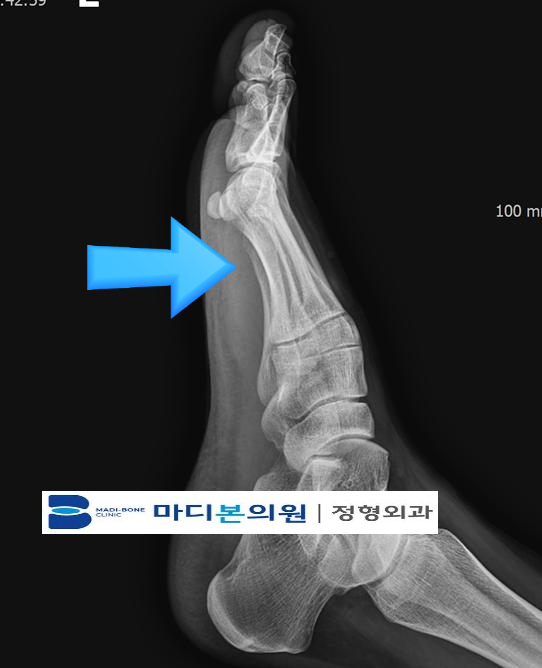
In this particular case,
plain radiographs demonstrated a clear fracture.
Although X-ray imaging can identify many fractures,
it does not provide complete information about soft tissue structures.
The Role and Limitations of X-ray Imaging
X-rays are the first-line imaging modality
for most ankle injuries.
They are effective for identifying:
- bone fractures
- joint alignment issues
- gross structural abnormalities
However, X-rays cannot visualize ligaments,
tendons, or nerves in detail.
This limitation becomes critical
when soft tissue injury is suspected.
Why Mechanism and Physical Examination Matter
Imaging should never be interpreted in isolation.
The mechanism of injury,
patient-reported symptoms,
and physical examination findings
provide essential context.
In this case, the way the injury occurred,
combined with localized instability and swelling,
raised concern for ligamentous damage.
Choosing the Right Advanced Imaging
Computed tomography (CT) is often used
to evaluate fracture patterns in detail.
However, when ligament or nerve injury is suspected,
magnetic resonance imaging (MRI)
offers superior diagnostic value.
MRI allows detailed assessment
of soft tissue structures
that cannot be evaluated on X-ray or CT alone.
Why MRI Was Necessary in This Case
Based on clinical findings and X-ray results,
there was a high suspicion
that injury extended beyond the bone.
For this reason,
an urgent MRI was requested
through a nearby radiology center.
Rapid imaging was essential
to avoid delaying appropriate treatment.
What the MRI Revealed
MRI findings confirmed complete rupture
of two lateral ankle ligaments.
This diagnosis significantly altered
the treatment strategy.
While certain fractures can be managed conservatively,
complete ligament rupture changes the timeline
and surgical considerations.
Why Timing Matters in Ligament Injuries
Ligament injuries differ from fractures
in their healing behavior.
Delayed treatment of complete ligament rupture
can make later reconstruction more difficult.
Scar formation and altered biomechanics
may compromise surgical outcomes.
Why Early Referral Was Necessary
Given the MRI findings,
the patient was placed in a temporary splint
to stabilize the ankle.
However, conservative observation
was not appropriate in this situation.
Early referral to a surgical center
was necessary to preserve long-term ankle stability.
Why “Waiting It Out” Can Be Risky
Many patients believe time alone will heal injuries.
While this is true for many sprains,
it does not apply to all cases.
Certain injuries require timely intervention
to prevent chronic instability and dysfunction.
Diagnosis Determines Outcome
The most important lesson from this case
is that accurate diagnosis drives appropriate care.
An ankle injury should not be judged
solely by how mild it appears externally.
Careful evaluation ensures that
serious injuries are not overlooked.
Related Articles
-
Why Injection Therapy Feels Different Today
-
Managing Disc Pain for the Long Term
-
Living With a Herniated Disc Without Surgery
Frequently Asked Questions (FAQ)
1. Are most ankle injuries sprains?
Yes, most are.
However, a small but important number involve fractures
or complete ligament rupture.
2. When is MRI necessary after an ankle injury?
MRI is helpful when ligament or nerve damage
is suspected based on clinical findings.
3. Can ligament rupture heal without surgery?
Partial tears may heal conservatively,
but complete ruptures often require surgical evaluation.
MADI-BONE CLINIC — Seolleung Station
MADI-BONE CLINIC
3F, 428 Seolleung-ro, Gangnam-gu, Seoul
Seolleung Station (Line 2) Exit 1 — 3 minutes on foot
📞 02-736-2626
⏰ Mon–Fri 09:30–18:30 / Sat 09:30–13:00