


Not all fractures require surgery. Learn how ligament damage changes treatment decisions after injury.
Simple Fracture vs Surgical Injury
By MADI-BONE CLINIC — Seolleung Station, Gangnam
Not All Fractures Are the Same
When patients are told they have a fracture,
their first question is often,
“Do I need surgery?”
The answer is not always straightforward.
Fractures vary widely in severity,
and not all of them require surgical treatment.
Understanding the difference between a simple fracture
and a surgical injury is essential
for proper decision-making.
What Is Considered a Simple Fracture?
A simple fracture generally refers to
a break in the bone that remains stable.
These fractures typically show:
- minimal or no displacement
- preserved joint alignment
- no significant damage to surrounding ligaments
In such cases,
treatment may involve immobilization,
activity modification,
and close follow-up.
Why Bones Alone Do Not Tell the Whole Story
Bones do not function independently.
Ligaments, tendons,
and surrounding soft tissues
play a crucial role in joint stability.
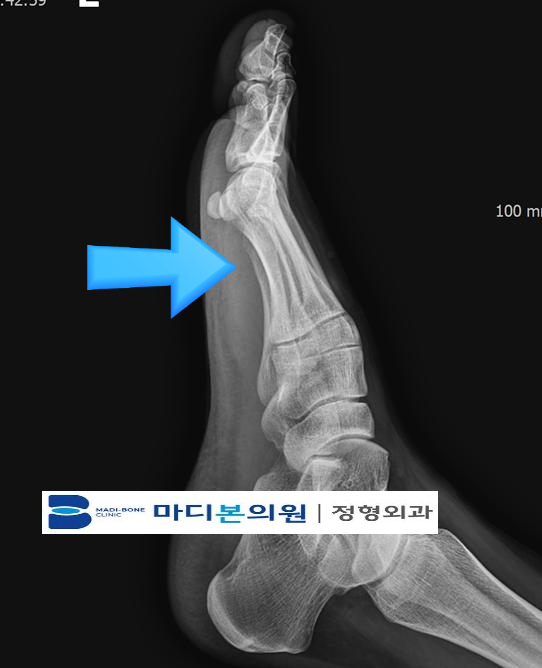
Even a small fracture
can become a serious injury
if the supporting structures are damaged.
When a Fracture Becomes a Surgical Injury
A fracture is more likely to require surgery
when it is accompanied by:
- complete ligament rupture
- joint instability
- loss of normal biomechanics
In these situations,
the primary issue is not just bone healing,
but restoring joint stability.
The Importance of Ligament Integrity
Ligaments are responsible
for guiding and controlling joint movement.
When multiple ligaments are completely torn,
the joint may become unstable,
even if the fracture itself appears minor.
This instability often cannot be corrected
with immobilization alone.
Why Timing Matters in Surgical Decisions
Ligament injuries are time-sensitive.
Delayed diagnosis or referral
can result in scar formation
and poor tissue quality.
This makes later reconstruction more complex
and may compromise outcomes.
Why MRI Plays a Key Role
X-rays are excellent for evaluating bone,
but they cannot adequately assess soft tissues.
MRI provides critical information about:
- ligament integrity
- tendon involvement
- associated cartilage or nerve injury
This information often determines
whether surgery should be considered.
Early Referral Is Not Overtreatment
Referring a patient to a surgical center
does not mean surgery is inevitable.
It ensures that all treatment options
are evaluated within the optimal time window.
Early referral protects long-term joint function.
What Happens If Surgical Injuries Are Missed?
Untreated ligament instability
can lead to:
- recurrent injuries
- chronic pain
- early degenerative joint changes
These outcomes can significantly affect
daily activities and quality of life.
Diagnosis Determines the Outcome
The most important factor after an injury
is not how mild it appears initially,
but whether the correct diagnosis is made.
Accurate assessment allows
for appropriate treatment decisions
and better long-term results.
Related Articles
-
Not All Ankle Sprains Are the Same
-
Why X-rays Are Sometimes Not Enough
-
When MRI Changes the Treatment Plan
Frequently Asked Questions (FAQ)
1. Do all fractures require surgery?
No.
Many fractures heal well with conservative treatment.
2. Why are ligament injuries more concerning?
Ligaments are essential for joint stability
and may not heal properly without timely intervention.
3. Can surgery still help if treatment is delayed?
Yes, but early evaluation generally leads
to better functional outcomes.
MADI-BONE CLINIC — Seolleung Station
MADI-BONE CLINIC
3F, 428 Seolleung-ro, Gangnam-gu, Seoul
Seolleung Station (Line 2) Exit 1 — 3 minutes on foot
📞 02-736-2626
Howdy! This article couldn’t be written any better!
Reading through this article reminds me of my previous roommate!
He continually kept preaching about this. I am going to forward
this information to him. Pretty sure he’s going to have a good
read. Thanks for sharing!