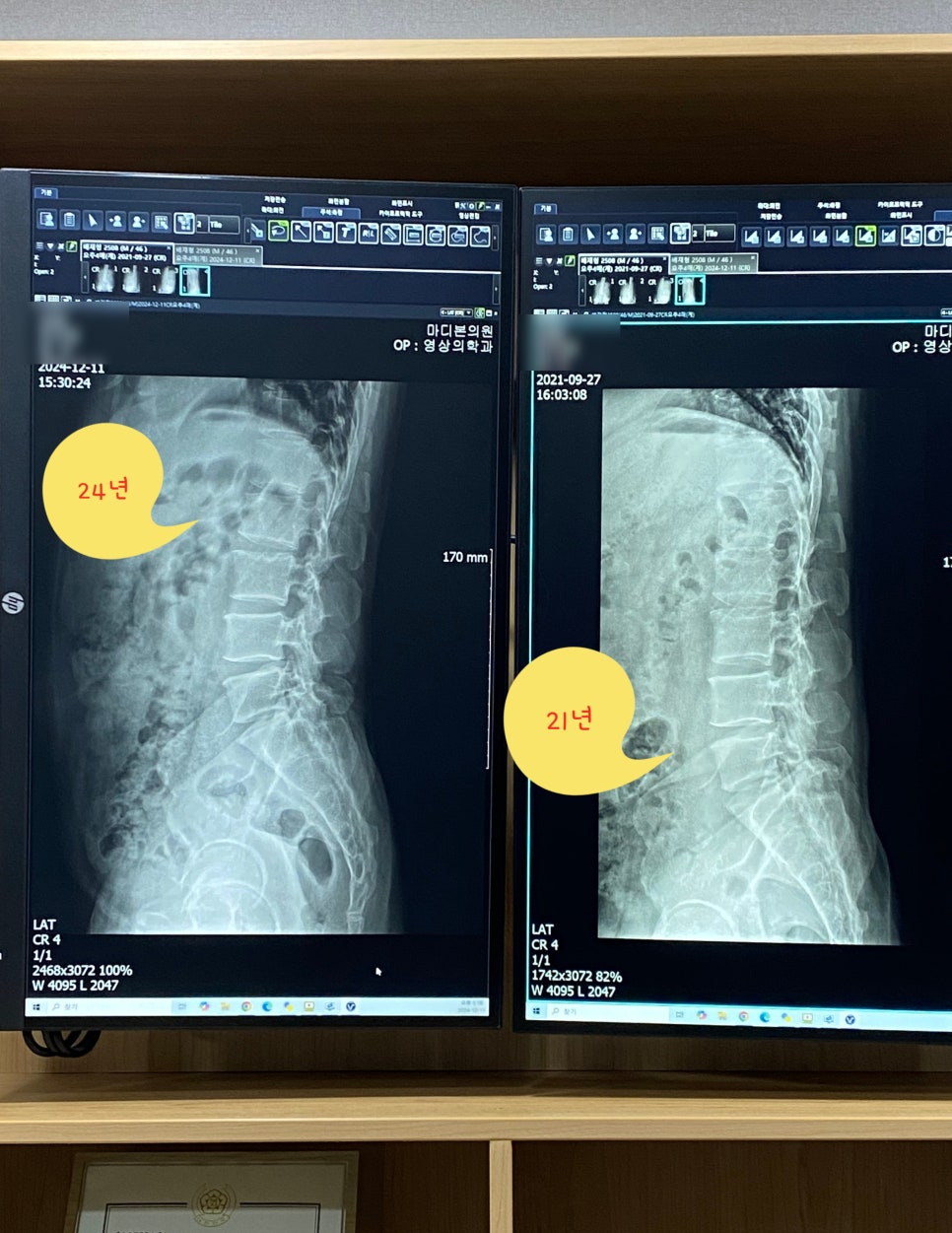
As discs degenerate, surrounding muscles and ligaments are affected. Learn how disc aging leads to pain and stiffness.
What Changes When Discs Begin to Degenerate?
By MADI-BONE CLINIC — Seolleung Station, Gangnam
Disc Degeneration Affects More Than the Disc Itself
When people hear the term “disc degeneration,”
they often imagine a problem limited to the disc alone.
In reality, disc changes affect
the entire surrounding support system,
including muscles, ligaments, and joints.
This is why disc-related issues
often present with a wide range of symptoms.
Loss of Flexibility and Shock Absorption
Healthy discs act as shock absorbers,
allowing smooth movement between vertebrae.
As degeneration progresses,
discs lose water content and elasticity.
This reduced flexibility increases mechanical stress
on nearby structures,
making movement less efficient.
Increased Strain on Muscles and Ligaments
When discs can no longer distribute load effectively,
muscles and ligaments compensate.
This compensation often leads to:
- muscle tightness
- early fatigue
- recurrent muscle strain
Over time, these tissues become overworked
and more susceptible to injury.
Why Pain Does Not Always Stay Localized
Disc degeneration may cause pain
that extends beyond the spine itself.
Neck disc changes can result in
shoulder or arm discomfort,
while lumbar disc degeneration
may affect the hips or legs.
This occurs because spinal nerves
travel from the spine to the extremities.
Early Symptoms Are Often Subtle
In the early stages,
disc degeneration may not cause severe pain.
Common early signs include:
- morning stiffness
- discomfort after prolonged sitting
- reduced tolerance for repetitive activity
These symptoms are frequently overlooked or ignored.
Why Symptoms Can Fluctuate
Patients often notice that pain comes and goes.
This fluctuation reflects the body’s ability
to temporarily compensate for structural changes.
When compensatory mechanisms fatigue,
symptoms become more noticeable.
Disc Degeneration and Recurrent Injury
As degeneration progresses,
the spine becomes more vulnerable to minor stress.
Simple movements or daily activities
may trigger pain episodes
that seem disproportionate to the activity.
This is a common reason patients experience
recurrent “flare-ups.”
Why Early Recognition Matters
Recognizing these changes early
allows for timely intervention.
Addressing muscle imbalance,
postural issues,
and movement patterns
can reduce excessive strain on the spine.
Early care helps slow progression
and preserve function.
Connecting Disc Changes to Daily Life
Disc degeneration does not exist in isolation.
Work habits, exercise routines,
and recovery patterns
all influence symptom severity.
Understanding this connection
empowers patients to take an active role
in managing their spine health.
What Comes Next
In the final article of this series,
we will discuss how disc degeneration
can be managed effectively without surgery.
This includes conservative treatments
and long-term lifestyle strategies
to protect spinal health.
MADI-BONE CLINIC — Seolleung Station
MADI-BONE CLINIC
3F, 428 Seolleung-ro, Gangnam-gu, Seoul
Seolleung Station (Line 2) Exit 1 — 3 minutes on foot
📞 02-736-2626