

MRI findings can change ankle injury treatment. Learn why ligament rupture requires timely surgical decisions.
When MRI Changes the Treatment Plan
By MADI-BONE CLINIC — Seolleung Station, Gangnam
When Imaging Alters the Entire Strategy
In orthopedic trauma care,
there are moments when a single test result
completely changes the treatment plan.
MRI findings can represent such a turning point,
especially in ankle injuries
that initially appear straightforward.
This is where diagnosis becomes decision-making.
Why MRI Goes Beyond Confirmation
MRI is often misunderstood
as merely a tool to “confirm” a diagnosis.
In reality, MRI frequently uncovers injuries
that cannot be inferred from X-rays alone.
This additional information
can significantly alter management.
The Significance of Complete Ligament Rupture
Ligaments play a crucial role
in maintaining ankle stability.
When one ligament is injured,
others often compensate.
However, complete rupture of multiple ligaments
compromises this balance.
Understanding Lateral Ankle Ligaments
The lateral ankle complex
consists of several ligaments
that stabilize the joint during movement.
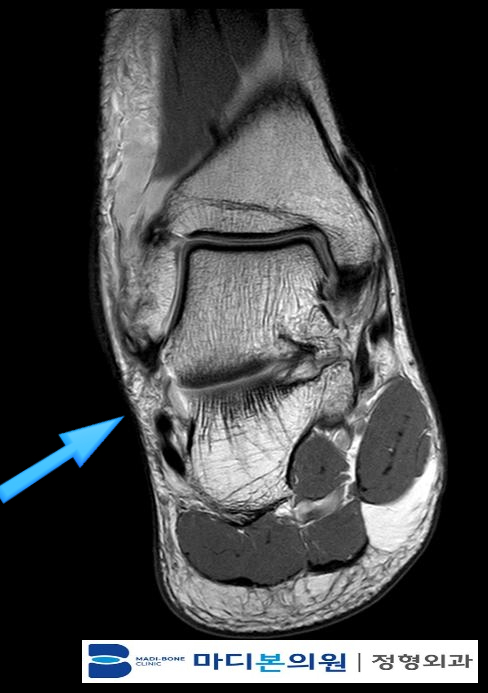
Complete rupture of two lateral ligaments,
as seen in this case,
represents a high-grade injury.
This finding alone shifts the treatment discussion.
Why Conservative Treatment May Not Be Enough
Some ligament injuries can heal
with immobilization and rehabilitation.
However, complete ruptures
carry a higher risk of chronic instability
if not addressed appropriately.
In these cases,
simple observation may be insufficient.
The Role of Timing in Ligament Healing
Unlike bone,
ligament healing is highly time-sensitive.
Delayed surgical repair
can be complicated by scar formation
and altered joint mechanics.
Early recognition preserves options.
Why “Wait and See” Can Be Harmful
The instinct to wait and observe
is understandable,
especially when swelling and pain are severe.
However, waiting too long
in cases of complete ligament rupture
can reduce the effectiveness of reconstruction.
Timing matters.
Temporary Stabilization Is Not Definitive Treatment
Initial splinting or bracing
serves an important role
in acute injury management.
It reduces pain and protects injured structures.
However, it does not replace
definitive decision-making.
Why Early Referral Is Sometimes Necessary
When MRI reveals injuries
that exceed the scope of conservative care,
early referral becomes critical.
This ensures that surgical options
are considered within the optimal window.
Referral is not failure.
It is appropriate care.
Balancing Urgency With Accuracy
Not every MRI finding requires surgery.
The decision depends on:
- patient age and activity level
- degree of instability
- functional demands
This balance defines orthopedic judgment.
Preventing Long-Term Ankle Instability
Chronic ankle instability
can significantly affect daily life.
Patients may experience:
- recurrent sprains
- persistent pain
- difficulty with uneven surfaces
Early intervention reduces these risks.
Why MRI Is a Decision-Making Tool
MRI does not simply provide images.
It provides clarity
at critical decision points.
In this case,
it guided the choice toward timely surgical referral.
Related Articles
-
Not All Ankle Sprains Are the Same
-
Why X-rays Are Sometimes Not Enough
-
Managing Disc Pain for the Long Term
Frequently Asked Questions (FAQ)
1. Does complete ligament rupture always require surgery?
Not always,
but it often requires surgical evaluation,
especially in active individuals.
2. How soon should MRI be performed after injury?
MRI is recommended when clinical findings
suggest ligament damage beyond a simple sprain.
3. Can delayed surgery still be effective?
Delayed surgery is possible,
but early intervention generally offers better outcomes.
MADI-BONE CLINIC — Seolleung Station
MADI-BONE CLINIC
3F, 428 Seolleung-ro, Gangnam-gu, Seoul
Seolleung Station (Line 2) Exit 1 — 3 minutes on foot
📞 02-736-2626
⏰ Mon–Fri 09:30–18:30 / Sat 09:30–13:00
What’s up, after reading this remarkable paragraph
i am as well happy to share my knowledge here with friends.