

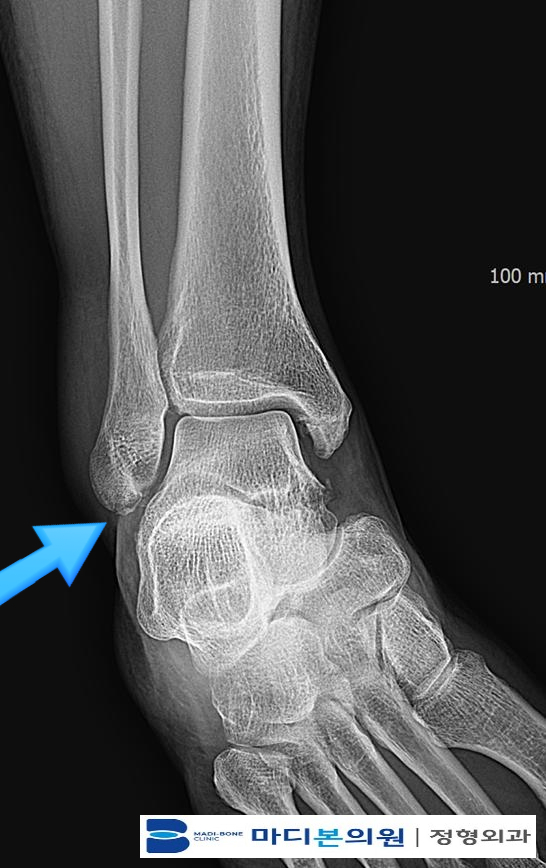
X-rays are essential but not always enough. Learn when CT or MRI is needed after ankle trauma.
Why X-rays Are Sometimes Not Enough
By MADI-BONE CLINIC — Seolleung Station, Gangnam
The First Step in Trauma Evaluation
When patients visit the clinic after an injury,
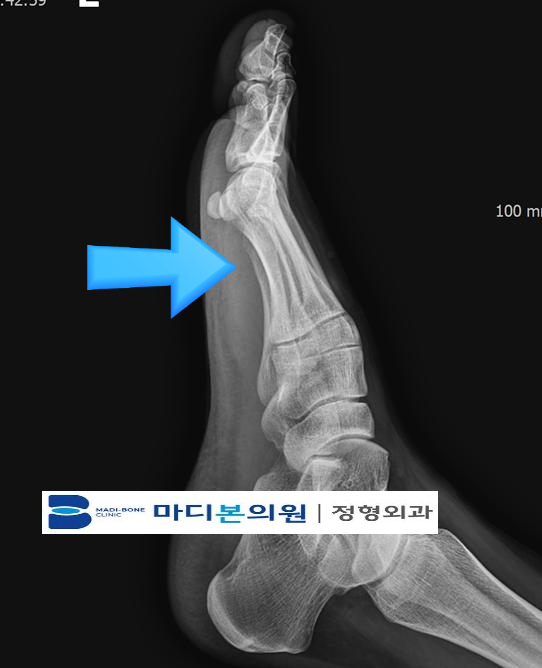
the first imaging study is usually an X-ray.
X-rays are fast, widely available,
and highly effective for identifying many fractures.
For this reason, they remain
the foundation of orthopedic trauma evaluation.
What X-rays Do Well
Plain radiographs provide valuable information about bone structures.
They are particularly useful for detecting:
- obvious fractures
- joint dislocations
- alignment abnormalities
In many cases,
this information alone is sufficient
to guide treatment.
The Hidden Limitations of X-ray Imaging
Despite their strengths,
X-rays have clear limitations.
They cannot adequately visualize:
- ligaments
- tendons
- cartilage
- nerves
When pain and instability persist
despite minimal findings on X-ray,
additional evaluation is required.
When Clinical Findings Do Not Match the Image
One of the most important moments in diagnosis
occurs when imaging findings
do not fully explain a patient’s symptoms.
Severe swelling, instability,
or disproportionate pain
may suggest deeper injury.
This discrepancy prompts further investigation.
CT Scans: Detailed Bone Assessment
Computed tomography (CT)
provides detailed, three-dimensional views of bone.
CT is particularly helpful when:
- fracture patterns are complex
- surgical planning is required
- small fractures are suspected
However, CT still offers limited information
about soft tissue integrity.
MRI: Seeing Beyond the Bone
Magnetic resonance imaging (MRI)
excels at evaluating soft tissues.
It allows visualization of:
- ligament integrity
- tendon injuries
- bone marrow edema
- associated nerve involvement
This makes MRI indispensable
when ligament rupture is suspected.
Choosing MRI Over CT
In some injuries,
bone damage is only part of the problem.
If ligament or nerve injury
will change the treatment plan,
MRI becomes the preferred study.
The goal is not to order more tests,
but to order the right test.
The Importance of Injury Mechanism
How an injury occurred
often provides clues
about what structures may be damaged.
Twisting injuries, high-energy impacts,
and forced inversion or eversion
increase the likelihood of ligament involvement.
This information guides imaging decisions.
Physical Examination Still Matters
Advanced imaging does not replace
a careful physical examination.
Findings such as joint laxity,
localized tenderness,
and abnormal movement
remain critical.
Imaging confirms what the examination suggests.
Why Early Imaging Decisions Matter
Timely and appropriate imaging
can alter the course of treatment.
Delayed diagnosis of ligament rupture
may lead to chronic instability
and poorer long-term outcomes.
Early identification allows timely referral
and appropriate intervention.
Avoiding Both Over- and Under-Diagnosis
Not every ankle injury requires MRI or CT.
At the same time,
not every injury can be dismissed as a simple sprain.
Balanced decision-making
protects patients from unnecessary testing
while ensuring serious injuries are not missed.
Imaging as Part of Clinical Judgment
Imaging is a tool,
not a substitute for judgment.
The most accurate diagnoses
come from combining:
- patient history
- physical examination
- appropriate imaging
This integrated approach
leads to better outcomes.
Related Articles
-
Not All Ankle Sprains Are the Same
-
Managing Disc Pain for the Long Term
-
Why Injection Therapy Feels Different Today
Frequently Asked Questions (FAQ)
1. Is X-ray always necessary after an ankle injury?
X-rays are often the first step,
especially when fracture is suspected.
2. Does everyone with ankle pain need an MRI?
No.
MRI is reserved for cases
where soft tissue injury is suspected.
3. Can CT replace MRI?
CT and MRI serve different purposes.
MRI is superior for ligament and tendon evaluation.
MADI-BONE CLINIC — Seolleung Station
MADI-BONE CLINIC
3F, 428 Seolleung-ro, Gangnam-gu, Seoul
Seolleung Station (Line 2) Exit 1 — 3 minutes on foot
📞 02-736-2626
⏰ Mon–Fri 09:30–18:30 / Sat 09:30–13:00
We absolutely love your blog and find almost all of your post’s to be just what I’m looking for.
Do you offer guest writers to write content for you?
I wouldn’t mind producing a post or elaborating on some of the subjects
you write with regards to here. Again, awesome web log!