
Written & Reviewed by
Dr. Choe Jeongheon
General Surgeon · Orthopedic Clinic Director · MD, PhD
Founder of MADI-BONE CLINIC, Seoul. 10+ years of experience in musculoskeletal medicine and private orthopedic care.
One of the most common questions we hear at MADI-BONE CLINIC is: “Do I need an MRI?”
It’s a reasonable question. MRI has become so synonymous with serious musculoskeletal diagnosis that many patients assume it’s always the necessary first step. In reality, the answer is more nuanced — and for a significant proportion of joint and tendon conditions, a well-performed ultrasound examination provides everything a clinician needs to make an accurate diagnosis and start treatment on the same day.
Here’s how to think about which imaging modality is right for your situation.
MRI and Ultrasound Are Not Competing — They Have Different Jobs
The most important thing to understand is that MRI and ultrasound are not better or worse versions of the same test. They image different things, in different ways, with different strengths.
MRI uses magnetic fields and radio waves to produce detailed cross-sectional images of internal structures. It excels at visualizing:
- Bone marrow, stress fractures, and subtle bony pathology
- Spinal discs, nerve roots, and the spinal cord
- Deep soft tissue structures — cruciate ligaments, menisci, labrum
- Tumors, cysts, and complex internal joint pathology
- The full extent of large muscle tears
Ultrasound uses high-frequency sound waves to produce real-time images of superficial soft tissue structures. It excels at visualizing:
- Tendons — including real-time dynamic assessment during movement
- Bursae and fluid collections
- Muscle tears and hematomas
- Peripheral nerves
- Joint effusions (fluid in the joint)
- Guiding injections with precision
The key difference: MRI gives you a detailed static picture of deep structures. Ultrasound gives you a real-time dynamic picture of superficial soft tissue — and crucially, it can be performed, interpreted, and acted upon immediately in the clinic.
When Ultrasound Is Sufficient — and Often Superior
For a wide range of common musculoskeletal conditions, ultrasound is not a compromise. It is the appropriate and often preferred imaging tool:
Tendon Conditions
Ultrasound is the gold standard for tendon imaging. It can detect tendinopathy, partial tears, full-thickness tears, and calcific deposits with high accuracy — and critically, it can assess tendon behavior dynamically during movement, which MRI cannot do.
For conditions like Achilles tendinopathy, rotator cuff tendinopathy, patellar tendinopathy, and plantar fasciitis, a high-quality ultrasound examination typically provides all the diagnostic information needed to begin treatment.
Shoulder Pain
For the majority of shoulder pain presentations — rotator cuff tears, subacromial bursitis, biceps tendon pathology, calcific tendinopathy — ultrasound provides accurate diagnosis comparable to MRI in experienced hands. It also allows immediate assessment of shoulder movement under load.
Soft Tissue Masses and Fluid
Ganglionic cysts, bursitis, joint effusions, and superficial soft tissue lumps are rapidly and accurately assessed with ultrasound — often in minutes.
Guided Injections
This is where ultrasound has a clear advantage over MRI: it can guide needles in real time. At MADI-BONE CLINIC, all injection procedures are performed under ultrasound or C-arm fluoroscopy guidance to ensure precise delivery to the target tissue — something MRI cannot facilitate.
The Same-Day Advantage
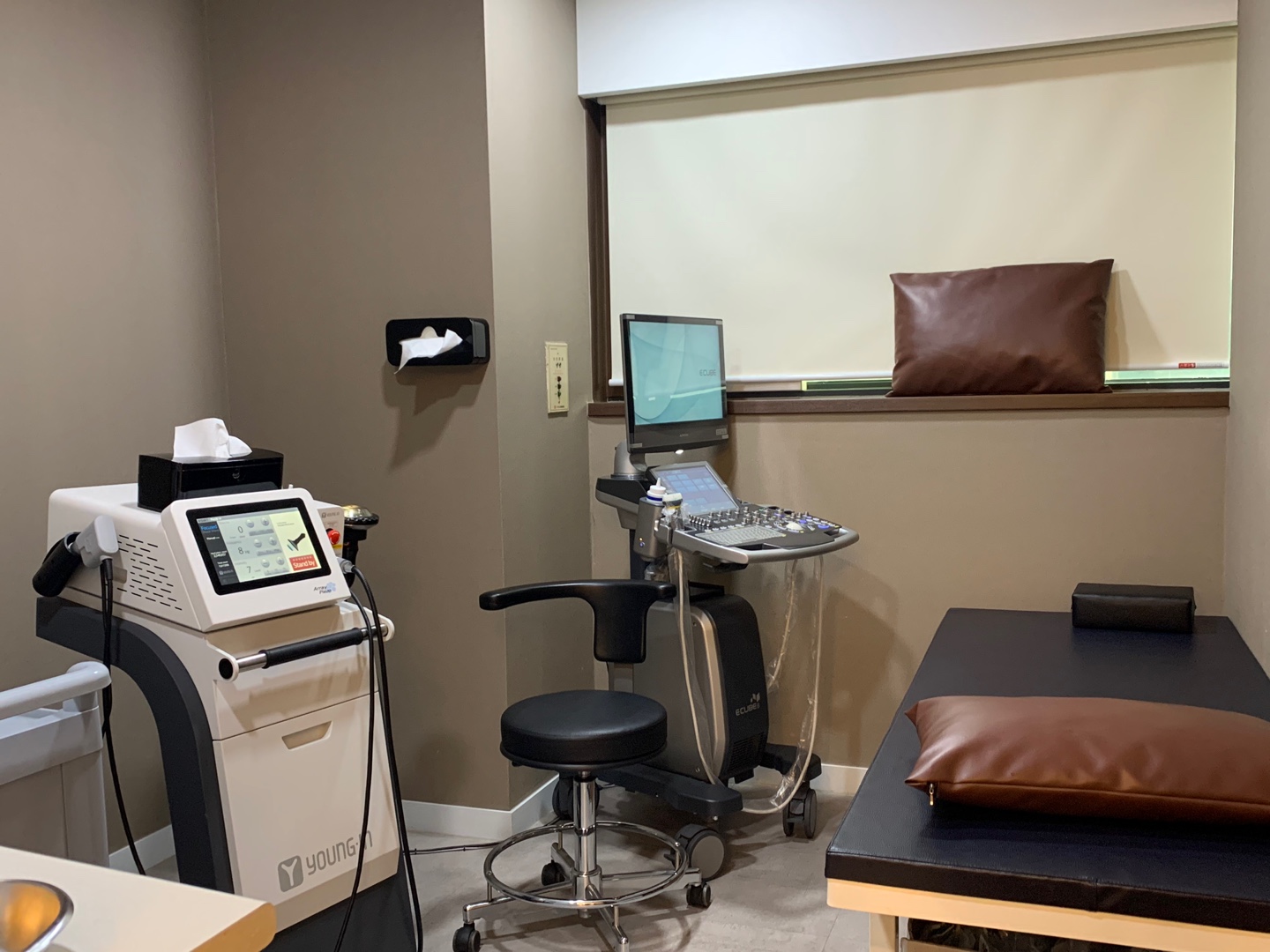
At MADI-BONE CLINIC, ultrasound imaging is performed in-clinic by the treating physician during your consultation. This means:
- No separate imaging appointment — diagnosis and treatment planning happen in a single visit
- No waiting days or weeks for imaging results before treatment can begin
- Dynamic assessment — the physician can move the joint and observe tendon behavior in real time, adding clinical information that a static MRI image cannot provide
- Immediate treatment if indicated — if an injection is appropriate, it can be performed under ultrasound guidance on the same day as diagnosis
For international patients visiting Seoul with limited time, this same-day diagnostic and treatment capability is particularly valuable. A patient can arrive at MADI-BONE CLINIC in the morning, receive a full ultrasound-guided diagnostic assessment, and begin treatment — all within a single appointment.
When MRI Is Genuinely Necessary
MRI is not always replaceable. There are specific clinical situations where it provides information that ultrasound cannot:
Spinal Conditions
For disc herniation, spinal stenosis, nerve root compression, and other spine pathology, MRI is the definitive imaging tool. It clearly visualizes disc morphology, neural structures, and the spinal canal in a way ultrasound cannot achieve due to the bony anatomy of the spine.
At MADI-BONE CLINIC, patients presenting with suspected disc herniation or nerve compression are referred for MRI as a standard part of the diagnostic workup before spinal injection procedures.
Internal Joint Structures
The cruciate ligaments of the knee, the menisci, the hip labrum, and the shoulder labrum lie deep within the joint and cannot be adequately visualized by ultrasound. Suspected ACL tears, meniscal tears, or labral pathology require MRI for definitive assessment.
Bone Pathology
Stress fractures, bone marrow edema, avascular necrosis, and early arthritic changes within bone are best assessed with MRI. X-ray may be normal in these conditions even when significant pathology is present.
When the Clinical Picture Is Unclear
If initial assessment — including ultrasound — does not provide a clear diagnosis, or if symptoms are atypical, MRI provides a comprehensive view of all relevant structures and can identify pathology that more targeted imaging might miss.
Side-by-Side Comparison
| Factor | Ultrasound | MRI |
|---|---|---|
| Availability | Same-day, in-clinic | Separate appointment, 1–7 days |
| Cost (Korea) | $30 – $80 | $300 – $600 |
| Tendons | ✅ Excellent | ✅ Good |
| Dynamic assessment | ✅ Real-time movement | ❌ Static only |
| Spinal discs / nerves | ❌ Cannot visualize | ✅ Gold standard |
| Knee ligaments / menisci | ❌ Limited | ✅ Gold standard |
| Guided injections | ✅ Real-time guidance | ❌ Not possible |
| Bone marrow / stress fractures | ❌ Cannot visualize | ✅ Excellent |
| Radiation | ✅ None | ✅ None |
| Claustrophobia concern | ✅ Not applicable | ⚠️ Can be an issue |
The Practical Answer: Start With a Clinical Assessment
The most efficient path to diagnosis is not “get an MRI” or “get an ultrasound” — it is to see a clinician who can examine you, assess your symptoms, and determine which imaging is actually needed for your specific situation.
In many cases, a thorough clinical examination combined with same-day ultrasound provides a complete diagnosis and allows treatment to begin immediately. In cases where MRI is genuinely indicated, a targeted referral for the specific imaging needed avoids unnecessary cost and delay.
At MADI-BONE CLINIC in Seoul’s Gangnam district, our standard approach is:
- Clinical examination and symptom assessment
- In-clinic ultrasound where indicated — same day, same appointment
- X-ray if bony pathology is suspected
- MRI referral if spinal, deep joint, or complex pathology requires further assessment
This approach means most patients leave their first appointment with a clear diagnosis — not a list of further tests to arrange.
This article was written and reviewed by Dr. Choe Jeongheon, General Surgeon · Orthopedic Clinic Director · MD, PhD. Founder of MADI-BONE CLINIC, Seoul. This content is for informational purposes only and does not constitute medical advice. Always consult a qualified healthcare professional for diagnosis and treatment planning.