
Written & Reviewed by
Dr. Choe Jeongheon
General Surgeon · Orthopedic Clinic Director · MD, PhD
Founder of MADI-BONE CLINIC, Seoul. 10+ years of experience in musculoskeletal medicine and private orthopedic care.
Back pain is one of the most common reasons international patients seek treatment in South Korea. And for good reason — Korea offers a wide range of spinal injection therapies at a fraction of the cost charged in the US, UK, or Australia, with shorter wait times and no referral delays.
But what do these procedures actually cost? And what should international patients know before booking a consultation?
Here’s a clear, clinic-level breakdown of disc injection costs in Korea for 2026.
Types of Disc Injections Available in Korea
Not all spinal injections are the same. The right procedure depends on your diagnosis, the location of your pain, and what your doctor is trying to achieve. Here are the most commonly performed injection types for disc-related conditions in Korea:
1. Epidural Steroid Injection (ESI)
The most commonly performed spinal injection worldwide. A corticosteroid is delivered into the epidural space to reduce inflammation around compressed nerve roots. Highly effective for disc herniation, sciatica, and spinal stenosis-related leg pain.
2. Selective Nerve Root Injection (SNRI)
A more targeted approach than a standard epidural. The injection is delivered directly to the specific nerve root causing symptoms — useful both as a treatment and as a diagnostic tool to confirm which level is responsible for pain.
3. Facet Joint Injection
Targets the small joints between vertebrae rather than the disc itself. Used for facet-mediated back pain, which is common in degenerative disc disease and age-related spinal changes.
4. Medial Branch Block
Targets the medial branch nerves that supply the facet joints. Often used as a diagnostic step before radiofrequency ablation (RFA) to confirm whether facet joints are the pain source.
5. Intradiscal Injection / Discography
Injection directly into the disc — used diagnostically to identify which disc is symptomatic, or therapeutically to deliver medication to the disc itself.
6. PRP (Platelet-Rich Plasma) Injection
A regenerative approach using the patient’s own blood plasma, concentrated and injected to stimulate tissue repair. Increasingly used for disc degeneration and facet joint conditions where conventional steroid injections have limited effect.
How Much Do Disc Injections Cost in Korea? (2026)
| Procedure | Korea (USD) | USA (USD) | UK (GBP) | Australia (AUD) |
|---|---|---|---|---|
| Epidural Steroid Injection | $300 – $800 | $1,500 – $6,000 | £800 – £2,500 | A$1,500 – A$4,000 |
| Selective Nerve Root Injection | $400 – $1,000 | $2,000 – $7,000 | £1,000 – £3,000 | A$2,000 – A$5,000 |
| Facet Joint Injection | $200 – $600 | $1,000 – $4,000 | £600 – £2,000 | A$1,000 – A$3,000 |
| Medial Branch Block | $200 – $500 | $1,000 – $3,500 | £600 – £1,800 | A$1,000 – A$2,500 |
| PRP Injection (Spinal) | $500 – $1,500 | $1,500 – $5,000 | £1,000 – £3,500 | A$2,000 – A$5,000 |
| Intradiscal Injection | $600 – $1,500 | $2,500 – $8,000 | £1,500 – £4,000 | A$2,500 – A$6,000 |
Figures are general estimates for informational purposes. Prices vary by facility, imaging guidance used, and number of levels treated. Always confirm pricing directly with your chosen clinic.
What Is Included in the Price?
Korean clinic pricing for spinal injections typically includes:
- The injection procedure itself
- Imaging guidance — most Korean clinics use C-arm fluoroscopy or ultrasound guidance as standard, ensuring precise needle placement
- Post-procedure monitoring (usually 30–60 minutes)
- A follow-up consultation report in English upon request
What is usually not included:
- Initial consultation fee ($50–$150 at most clinics)
- Diagnostic imaging if not already available (X-ray: $50–$150, MRI: $300–$600)
- Medication prescribed after the procedure
Why Are Korean Prices So Much Lower?
The cost difference between Korea and English-speaking countries is not a reflection of quality. Several structural factors explain the gap:
Lower overhead costs: Korean clinics operate with significantly lower facility and administrative costs than US or UK equivalents. Malpractice insurance costs are also substantially lower.
Competitive market: Korea has a high density of specialist clinics, particularly in Seoul’s Gangnam district. Competition keeps pricing transparent and reasonable.
Government regulation: Korea’s healthcare pricing is regulated, which limits extreme price variation between facilities and protects patients from surprise billing.
No insurer markup: In the US, procedure costs are often inflated to account for insurer negotiations. Korean clinics — particularly those serving international self-pay patients — price more directly.
What to Expect at MADI-BONE CLINIC
At MADI-BONE CLINIC in Seoul’s Gangnam district, spinal injection procedures follow a structured process designed for both safety and efficiency — particularly for international patients with limited time in Korea.
A typical visit for a first-time international patient looks like this:
- Day 1 — Consultation and imaging: Review of existing MRI or X-ray, physical examination, discussion of treatment options. If imaging is needed, X-ray can be performed same-day; MRI referral arranged if required.
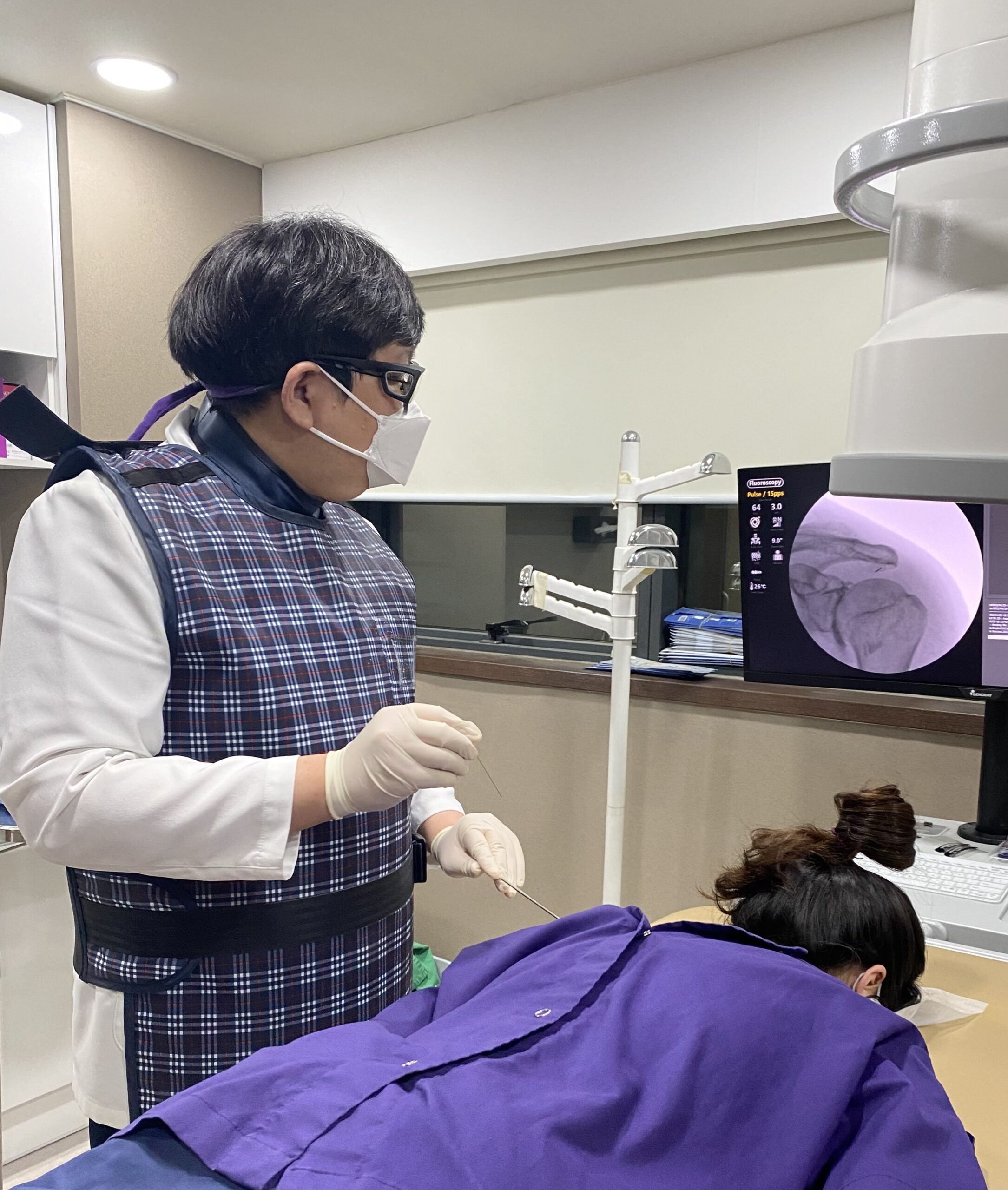
- Day 2 or 3 — Injection procedure: Performed under C-arm fluoroscopy guidance for precision. The procedure itself takes 15–30 minutes. Post-procedure rest of 30–60 minutes at the clinic.
- Day 3–5 — Follow-up: Assessment of initial response, adjustment of plan if needed, documentation prepared for home physician or insurer.
Most international patients complete a full diagnostic and treatment cycle within 3–5 days in Seoul.
Does Insurance Cover Disc Injections in Korea?
Many international health insurance plans — including Cigna Global, Aetna International, and Allianz Care — cover medically necessary spinal injection procedures in South Korea, subject to pre-authorization.
Key steps before traveling:
- Contact your insurer and confirm South Korea is within your coverage territory
- Request pre-authorization with supporting documentation from your home physician
- Ask your Korean clinic for an English-language medical necessity letter if required
- Keep all invoices and procedure reports for reimbursement claims
Self-pay patients who submit reimbursement claims after returning home often still achieve significant net savings compared to paying domestic prices — even after accounting for flights and accommodation.
Is a Disc Injection Right for You?
Spinal injections are not appropriate for every back pain condition. They work best when:
- Pain has a clear inflammatory or nerve compression component
- Conservative treatments (physiotherapy, oral medication) have not provided sufficient relief
- The pain source has been clearly identified through imaging
- Surgery is being considered but non-surgical options have not been fully explored
At MADI-BONE CLINIC, we do not recommend injection therapy unless it is genuinely indicated for your specific condition. Our goal is to identify the most appropriate treatment — whether that is injection therapy, shockwave, manual therapy, rehabilitation, or a combination — based on your individual diagnosis and lifestyle.
If you’re considering disc injection treatment in Seoul, we’re happy to review your MRI or X-ray remotely before you travel, and provide an honest assessment of whether injection therapy is likely to help your specific condition.
This article was written and reviewed by Dr. Choe Jeongheon, General Surgeon · Orthopedic Clinic Director · MD, PhD. Founder of MADI-BONE CLINIC, Seoul. Cost figures are general estimates based on publicly available data and are for informational purposes only. Always consult directly with your chosen facility for accurate pricing and to determine whether a procedure is appropriate for your condition.